You are here: Home page » History
You are here: Home page » History
Like flipping through a colorful picture album, we journey through the decades: from the beginnings to the present day. Discover the traces of the past and the developments that made Rimpar the place we celebrate today.
The earliest settlement in the area of the Rimpar district took place at the beginning of the Neolithic period (Early Neolithic). The first farmers and livestock breeders migrated and settled in the area known today as „Hinter der Kirche.“ Based on the decorations of their vessels (surrounding lines and bands, later with punctures and other decorative elements), this period is referred to as Linear Pottery culture or simply Bandkeramik (5500 – 4900 BC).
Rimpar – „Behind the church“: Grave of the Early Neolithic, 5500 – 4900 BC.
Photo: Hans Winzlmaier
In addition to houses averaging 25 meters in length and 6 meters in width, constructed using post-and-beam techniques with wattle-and-daub and partially split-plank walls, the use of stone tools made of hard rock (amphibolite) and siliceous rock (flint) with a typical range of forms is characteristic of this period: polished transverse adzes and highly arched stone wedges—so-called „shoe-last celts,“ in later times perforated axes and disc mace-heads, as well as sickle blades, drills, scrapers, and arrowhead tips. The deceased were buried lying on their sides with bent legs, in a crouched position, often with ceramic vessels and stone tools as grave goods.
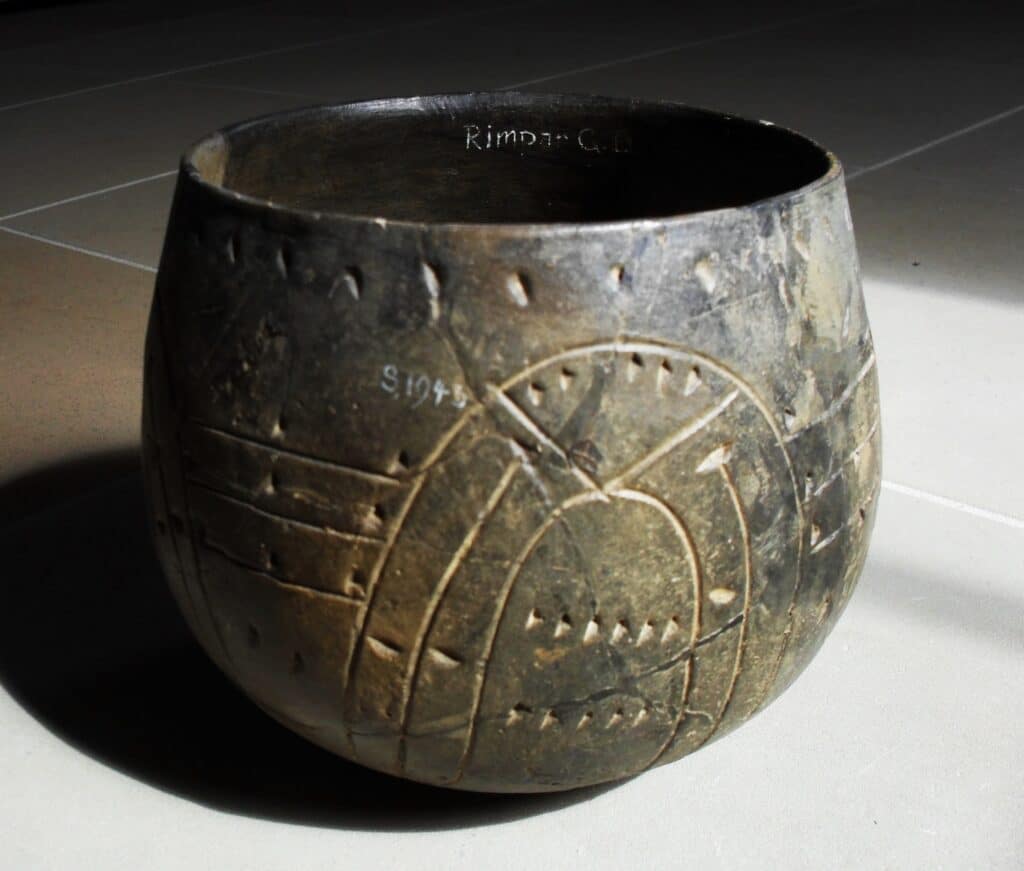
In Rimpar, excavations by the „General Conservatory of the Art Monuments and Antiquities of Bavaria“ under Prof. Dr. Hock took place as early as 1913 and 1914. During the construction of the Maximilian Kolbe School in 1970, school inspector Alfons Arnold salvaged numerous ceramic shards, including the remains of a reconstructible, large storage vessel with a capacity of about 50 liters, grinding and rubbing stones, many chunks of daub, animal bones, and a crouched burial. Starting in 1980, during field surveys in the area of the remaining settlement, Hans Winzlmaier found, in addition to several stone tools and ceramic remains, the clay shard of a ritual vessel featuring the extremely rare depiction of a human face—the oldest „portrait“ from Rimpar. It presumably represents a fertility goddess or a revered ancestor.
Rimpar – „Behind the church“: Early Neolithic facial representation, h=4.1 cm, 5500 – 4900 BC.
Photo: Hans Winzlmaier
Drawing: Bavarian State Office for the Preservation of Historical Monuments, Rimpar Local File, L. Holzner
After the end of the Linear Pottery Culture, no further Stone Age settlements can be reliably detected in Rimpar. Isolated shards and a few fragments of stone tools from subsequent epochs (Middle and Late Neolithic) do not suggest a continuous, permanent settlement.
Similarly, the discovery of a woman’s grave dating to the Late Neolithic Corded Ware culture (ca. 2800–2300 B.C.), made during an expansion of the „Alte Würzburger Straße“ gas compression station in 2020 (Field 3, Teicht), yielded no evidence of an associated settlement from that period.
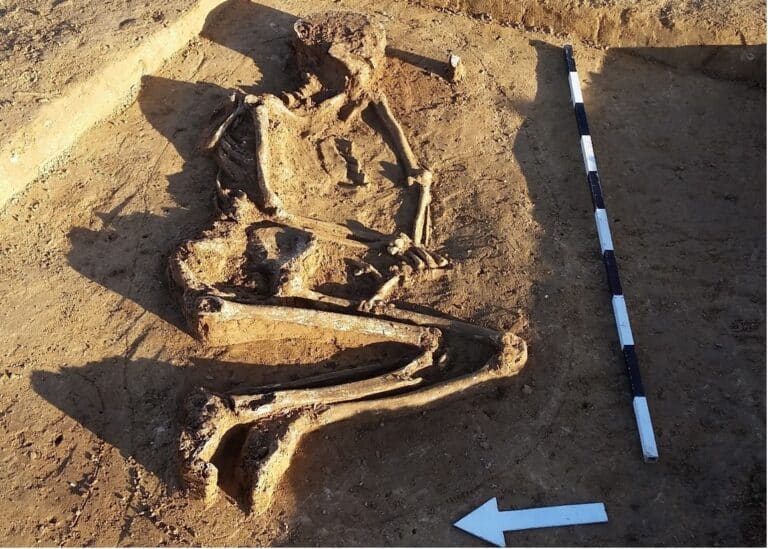
Rimpar – Gas compressor station, „3. Teicht“ field: Burial from the end of the Neolithic period, approx. 2800 – 2300 BC, discovered in 2020
Photo: Hans Winzlmaier
While evidence from the subsequent Bronze Age (around 2000–1200 B.C.) and Urnfield Period (1200–800 BCE) can be found in our vicinity (including a field of burial mounds in the Gramschatzer Forest near Erbshausen), there is no definitive evidence of a settlement at Rimpar during these periods either.
It wasn’t until the Early Iron Age (Hallstatt period, 800–450 B.C.) that this changed. During the construction of a barn in 1929 in what is now the „Krautäcker“ area, two bowls, various shards, smelting clay, one metal dagger, two burial sites, and human bones were recovered, indicating settlement by Celts who had by then taken up residence here. There is also a burial mound in the „Reuterlein“ field within Rimpar’s municipal boundaries, presumably dating from this period, though it was already excavated around 1900. Unfortunately, no further details are known about it. Two large fields of burial mounds from the Hallstatt period, located in the Gramschatzer Forest, lie outside the Rimpar municipal boundaries.
A Celtic chopping knife, found in the district of Maidbronn, and settlement finds in surrounding communities show that our area was inhabited by Celts even in the Late Iron Age (La Tène period 400 – 15 BC).
The end of the Celtic era (around 15 B.C.) in our region is marked by the influx of Germanic tribes—first the Alemanni and the Thuringians, and finally the Franks.
Evidence of the expansion of the Franks in the Early Middle Ages (Merovingian period, ca. 481 – 751 AD), the discovery of two 7th-century graves (unearthed in 1924 and 1966 in the area of Günterslebener Straße) provided evidence of a Frankish settlement. The place name „Rintburi“ or „Rimpure“ likely originated during this period as well. It refers to a cattle barn, presumably with an associated settlement that was evidently long-lasting and was first mentioned in writing in 1126, a date that can be reliably verified.
Hans Winzlmaier
Sources:
Arnold, Alfons: Rimpar in the Shadow of the Castle, Rimpar 1964
Arnold, Alfons: Nomen est Omen, Rimpar 1963
Bavarian State Office for the Preservation of Historical Monuments, Seehof Castle Branch Office: Rimpar Local File
Society for Archaeology in Bavaria (Ed.): Archaeology in Bavaria – Window to the Past, Regensburg 2006
Pescheck, Christian: Prehistory and Early History of Lower Franconia, Würzburg 1961
Rufflar, Ingrid (Ed.): Rimpar – Hinter der Kirche, Self-published 2002
Winzlmaier, Hans: Traces of Past Millennia – On the Prehistory of Rimpar, Gramschatz, and Maidbronn, Rimpar 2021
An 11th-century property register of the Kitzingen Monastery states that the monastery owned a manorial estate in Rimpar consisting of 12 farms. Each of these farms had one “Hube” of arable land, meadows, and the like (1 hube = 17 ha). The name Rimpar (Rintburi) appears for the first time in this register. However, the name cannot be precisely dated (1070 or 1100) from a scholarly perspective and is therefore not suitable as the basis for an anniversary.
Another monastery charter has been preserved from the year 1126. This has made the 900-year anniversary of Rimpar (Rimpure), which is fixed in time and name, possible.
In this document, the wife of Poppo of Rimpar (Rimpure) and her children are released from all obligations to the monastery.
It is likely that the Rimpar family carried out administrative duties at Fronhof. By the 12th century, some members of the family were already citizens of Würzburg; they also practiced various trades, thereby forfeiting their noble privileges.
In 1213, the residents of Rimpar sought the protection of the Bishop of Würzburg.
Otto von Lobdeburg, Bishop of Würzburg, certifies: The residents of Rimpar, listed by name, appeared before him and transferred their properties in the village of Rimpar to the Church of Würzburg. Subsequently, the bishop returned these properties to them with the right of inheritance in exchange for the payment of an annual rent.
The following is a list of the residents and the wheat taxes they are required to pay. They must pay these taxes between August 15 and September 8.
The bishop now places the inhabitants under the protection of the Church of Würzburg. He promises them that the properties handed over may neither be sold nor pledged, nor may they be alienated from the Church of Würzburg in any other way.
The names of the Rimpar residents listed here are first names and have no connection to our current names.
In 1243, the noble family of Grumbach of Burgrumbach, which was held in high esteem by the emperors, died out in the male line.
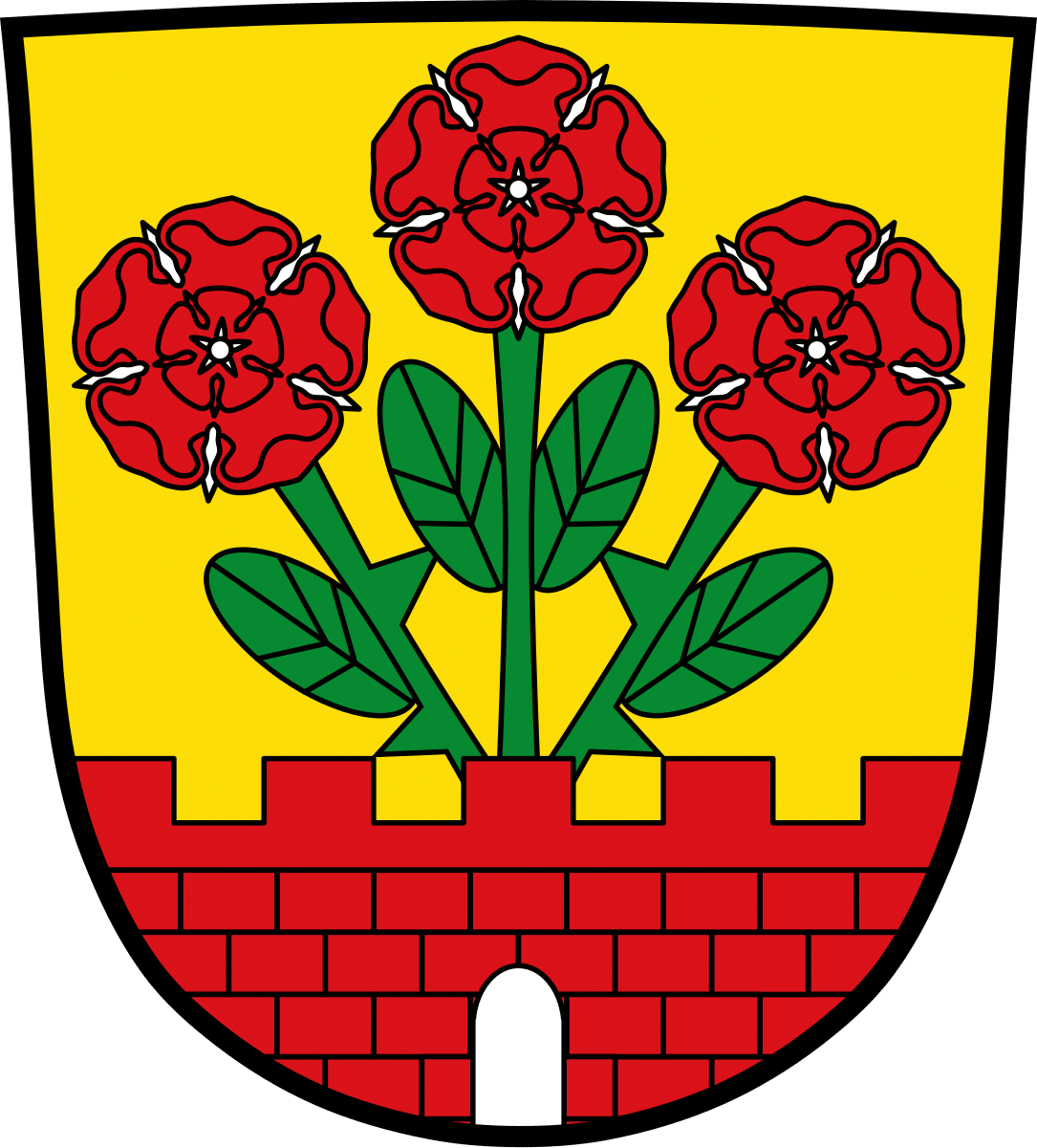
The estates passed to their relatives, the Counts of Rieneck. During the same period, a new family of the lower nobility emerged from the von Wolfskeel family. They later took the name Grumbach. Both families, the Wolfskeels and the Grumbachs, have the same coat of arms: a Moor on a gold field, holding three red roses in his right hand.
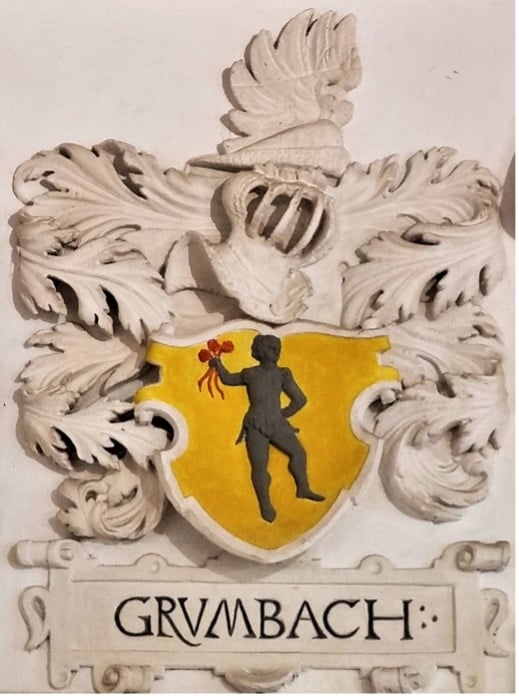
The Rimpar Grumbach Coat of Arms in the Knights' Hall
Photo: Hans Winzlmaier
Eberhard, the founder of the Rimpar line, purchased two-thirds of Burggrumbach Castle from the Counts of Rieneck in 1328. Wiprecht von Grumbach purchased the remaining third of the castle from Ulrich von Hanau. Eberhard’s purchase agreement also included the properties that the Counts of Rieneck held in Rimpar, including the manorial estate of the Kitzingen Monastery (the former Niederhof).
During the 14th century, there was no castle yet in Rimpar, but rather fortified houses that, however, had only minor defensive capability. The first reference to a fortification can be seen in a partition agreement from 1469 between the brothers Eberhard and Heinz von Grumbach. The large tower is mentioned here, which, however, only reached a height up to the eaves of the south wing. It is also mentioned that if they wanted to build the tower higher, each of the two should contribute 50 guilders toward it.
Eberhard's tomb is an early work by Tilman Riemenschneider and is located in the Catholic parish church in Rimpar. The project includes two residential buildings, the gate tower, and the fountain.
It is likely that extensive construction took place in the years that followed. The 1499 feudal contract between Konrad von Grumbach and the Bishopric of Würzburg mentions: a castle with its towers, gates, residential buildings, keep, moats, ….
The south wing with its stepped gable and rare curtain-arch windows was built, the large tower was raised, though one story lower than it is today (in 1558 it was described as a tall tower with a striking clock), and then the western castle wall with 4 towers and 24 embrasures.
An outstanding figure of the 15th century from the Rimpar lineage was Johann III, Prince-Bishop from 1455 to 1466. He had the Franconian Ducal Sword made, which is housed today in the Treasury of the Munich Residenz. He maintained a good relationship with his citizenry, and abuses in the trades were remedied. He persuaded the Pope to place the Jews under general imperial protection. A new fire code was established. During his reign, a papal decree was issued stipulating that the bells should ring three times a day. Prince-Bishop Johann III of Grumbach died on April 11, 1466.
A prominent figure of the 16th century was Wilhelm von Grumbach, born in 1503, the son of Konrad von Grumbach and Eva von Schwaigern. The Peasants’ War of 1525, which raged primarily in Franconia, occurred during his tenure. The Peasants’ War also left its mark on the castle. The stepped gable of the west facade and the adjoining roof were destroyed by fire and consequently had to be rebuilt. Some rafters have been preserved in the roof truss, and their age has been dated to 1525 or 1526. There is no evidence to support the claim that Florian Geyer, the well-known peasant leader, was Wilhelm von Grumbach’s brother-in-law and that Wilhelm had him murdered. From 1528 to 1541, Wilhelm served the Bishopric of Würzburg as bailiff of Dettelbach and Stadtschwarzach. At the emperor’s request, he became an advisor to the unruly Margrave Albrecht Alcibiades and, in the same year, court marshal to the new Prince-Bishop Konrad von Bibra. The Prince-Bishop died in 1544.
Under his successor, Melchior von Zobel, disagreements arose between him and Wilhelm. He therefore entered the service of Margrave Albrecht Alcibiades and became governor of the Margraviate of Kulmbach–Bayreuth in 1551. In 1553, all of Grumbach’s estates were confiscated by Prince-Bishop Zobel on the grounds that Grumbach was a violator of the peace, since he had supported the margraves in their war against Würzburg, among other things. After five years of unsuccessful legal battles, Wilhelm attempted to capture the bishop in order to abduct him to France (he had been a colonel in the French Crown Army since 1557). The abduction failed, and the bishop was killed in the process.
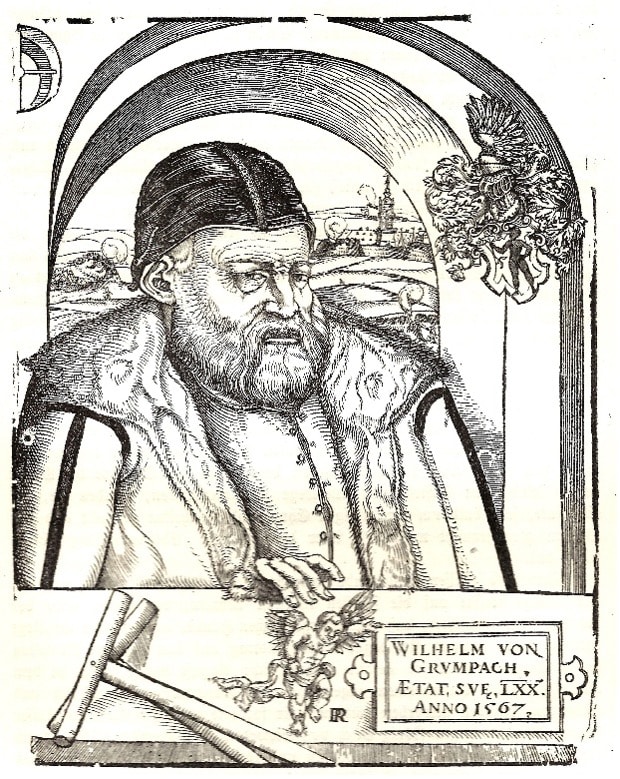
In 1563, Wilhelm von Grumbach raided the city of Würzburg in an attempt to reclaim his estates. As a result, he was outlawed by Emperor Ferdinand I and later by Emperor Maximilian II for violating the peace of the realm. After an imperial execution force captured Gotha, where he was staying at the time, he was executed in the most gruesome manner on April 18, 1567, in Gotha’s market square. Wilhelm von Grumbach was not executed primarily for the murder of Prince-Bishop Melchior von Zobel, but rather for breach of the peace and fears of a noble revolt against the princes.
Wilhelm von Grumbach
Woodcut by Peter Gottland, around 1567
After the death of Wilhelm von Grumbach, his son Konrad had many advocates and tried by prostrating himself before Prince-Bishop Wirsberg to regain his estates. He ultimately had to pay 50,000 guilders and could only get back part of his estates as a fief. When money was lacking, he extorted it from his subjects. This is shown by a 10-page letter that his protected Jew Schmul Jud addressed to the Emperor. In it, he described the extortion against him and his family. Furthermore, Konrad frequently borrowed money without repaying it.
In 1593 Konrad had to sell the castle and his properties to the Prince-Bishopric of Würzburg. Since the ground became too hot for Konrad and his son Wilhelm because of outstanding debts, they fled to Bohemia. Before the Imperial Chamber Court in Regensburg in 1596, the creditors achieved that the remaining property of Konrad and his son was placed under the receivership of the Prince-Bishop. The noble Lawinia von Russwurm enforced that both father and son Grumbach were placed under the imperial ban. Thereupon both fled to imperial asylum in Roth near Nuremberg. They were summoned to come to Würzburg in the year 1599.
However, only Konrad came and lived with his son Wolf in Schwanfeld.
In the same year Conrad died in utter poverty, followed by his sons in 1601 and 1603. With this, the Rimpar line of the Grumbachs became extinct. Their reputation was extremely bad; the knighthood described the Grumbach clan as “wicked, evil ravens laying an evil egg.".
From the year 1593, the castle had become a princely country residence. Even before the purchase agreement, which was concluded in 1593, the shell of the east wing had been completed. This is documented by a so-called “Feierabendziegel" (the last tile of a roof) with the Echter coat of arms and the year 1592. Prince-Bishop Julius Echter had the magnificent inner gate built and the fountain redesigned, and furthermore had the large tower raised by one storey. All towers received so-called "onion domes". Inside the buildings, apart from the knights' halls, the rooms were redesigned.
Below the castle, a small court garden with a fountain and the so-called pleasure palace (Lusthaus) with arcades and a stair tower are built in 1601. In 1614, the magnificent town hall on the market square is built with a tavern. In the years 1607–1609, the church, especially the tower, is renovated. Julius Echter was very often in his pleasure palace, especially when the plague was raging in Würzburg.
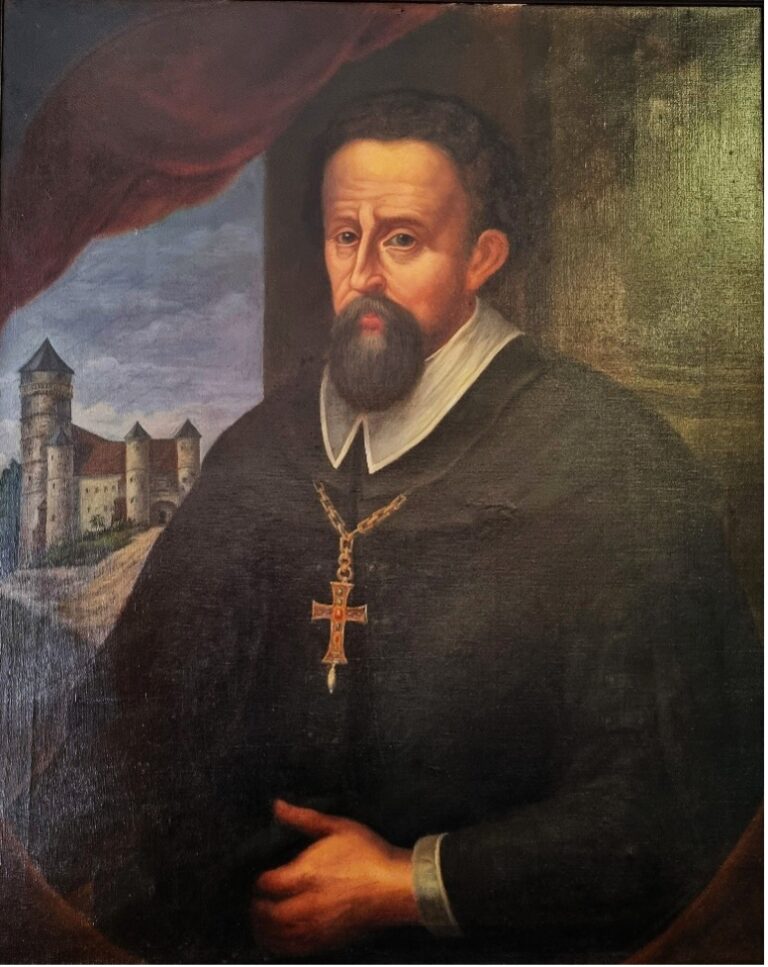
Prince-Bishop Julius Echter with Rimpar Castle; Property: Rimpar Catholic Parish Foundation
Photo: Hans Winzlmaier
After the Thirty Years” War, extensive renovations of the building and tower roofs were necessary at the castle, and a collapsed wall at the well had to be rebuilt. The Prince-Bishops visited their castle again. The Prince-Bishops of Dernbach, Guttenberg, Greiffenclau, Johann Philipp Franz von Schönborn, and Friedrich Carl von Schönborn are documented. The last visit of a Prince-Bishop is recorded in the mid-18th century. From then on, the former princely castle was downgraded to a simple country estate. Due to its poor structural condition, the Princely Chamber decided in 1780 to dismantle the castle in Rimpar. In the same year, demolition work began and lasted into the 1790s. The west wing was demolished almost down to courtyard level, the ditches were filled in, and all the "Walser domes" of the towers were replaced by blunt conical roofs.
After secularization in 1803, the castle housed a forestry office and district forestry station, respectively. Pastor Müller writes in his notes, “in the old Franconian knights“ hall, adorned with many coats of arms, where joyful cups once circulated, peas and vetches are threshed today."
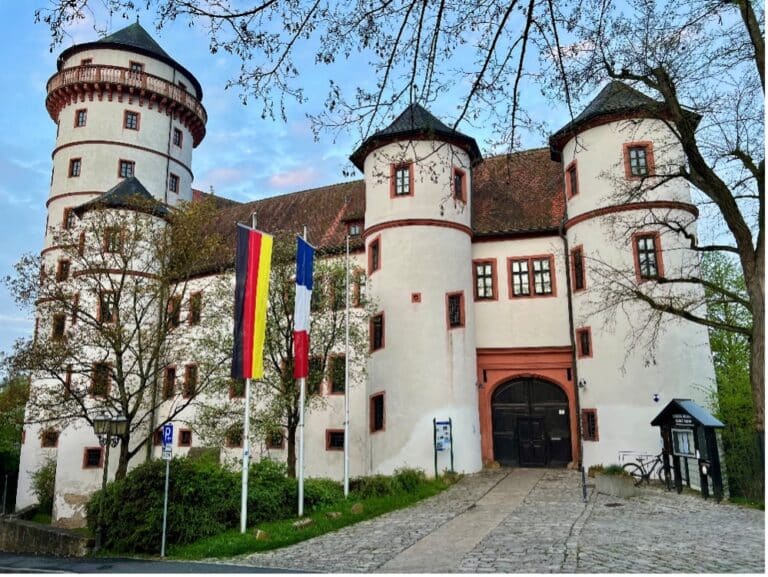
Grumbach Castle, east wing with Julius Tower
Photo: Nadja Kess
Edwin Hamberger
Sources:
Author Edwin Hamberger
Architectural research
The lower noble family of von Rimpar
Historical documents of Rimpar,
The Princely Country Castle of Rimpar in the 17th and 18th Centuries
The Rimpar Castle, from fortress to palace
Wilhelm von Grumbach, a Franconian imperial knight
As a consequence of the French Revolution of 1789, France's declaration of war on Austria in 1792 marked the beginning of a disastrous period of war for our country, which only ended in 1815 with the Battle of Waterloo and the final defeat of Napoleon.
In 1796, the French general Jourdan advanced into the Franconian region with 76,000 men and occupied Würzburg. Troops had to be provisioned by the population, and French soldiers marched through the villages looting. Sixty French dragoons had set up camp in the castle courtyard in Rimpar, demanding food, extorting money, and robbing inhabitants.
In the Battle of Würzburg near Kürnach/Estenfeld/Maidbronn, Archduke Charles of Austria defeated General Jourdan.
During the subsequent Napoleonic era, Franconia repeatedly served as a staging and retreat area for troops, with correspondingly dire consequences for the population, such as billeting, the recruitment of young men, and demands for food for troops and horses, which brought our villages to the brink of ruin. For example, in the year 1800, 600 soldiers were quartered in Rimpar for 74 days; Bavarian cavalry spent three months here in 1802; 800 French soldiers marched in for 3 days in 1805; further billeting of French soldiers took place in 1806; and in 1813, when the fortunes of war had turned against Napoleon, 3,000 Cossacks descended upon Rimpar, set up bivouac here, and plundered food supplies. When they moved on, „the troughs were empty and 3 farmers lay slain.“ (Arnold 1965, p. 190)
Because Napoleon wanted to strengthen the Electorate of Bavaria as an ally, a treaty had already been agreed upon between Paris and Munich in February 1802 regarding the transfer of the Franconian bishoprics, and thus also the Prince-Bishopric of Würzburg, to Bavaria. Anticipating this, Bavaria subsequently occupied them militarily. The Imperial Church was disempowered (secularization of 1803), monasteries and churches were dissolved and also plundered. For example, the ornate Franconian ducal sword of Prince-Bishop Johann III (reigned 1455–1466), who hailed from the Rimpar Grumbach line, was taken to Munich, where it became part of the treasury of the Wittelsbach ruling house. Following the Peace of Pressburg (December 1805), Bavaria was officially elevated to a kingdom on January 1, 1806, and received, among other territories, the Prince-Bishopric of Würzburg and thus also Rimpar. After a brief change of possession (transferred in 1806 to Grand Duke Ferdinand III of Tuscany in a territorial exchange), it finally fell to the Kingdom of Bavaria in 1814.
At the beginning of the 19th century, three-quarters of Franconia's residents made their living from agriculture, with artisans also mostly relying on secondary agricultural income. Rimpar was likewise a farming village; its main sources of income were crop farming, livestock breeding, forestry, and viticulture—though the latter declined drastically from the last quarter of the 19th century onward due to pests and fungal diseases (phylloxera and powdery mildew).
Due to crop failures (1816/17), famines (1846/47) and restrictive laws (e.g., lack of the right to free settlement; marriage only permitted with state approval upon proof of land ownership or assets, or secured employment – farmhands, maids, and servants were therefore unable to marry), a wave of emigration occurred.
Between 1844 and 1850, three sons of the Jewish citizen Abraham Löw Lehmann, among others, left Rimpar for America and established the firm „Lehman Brothers“ in Montgomery, Alabama. Later, the company headquarters was relocated to New York, where the well-known banking house of the same name was founded.
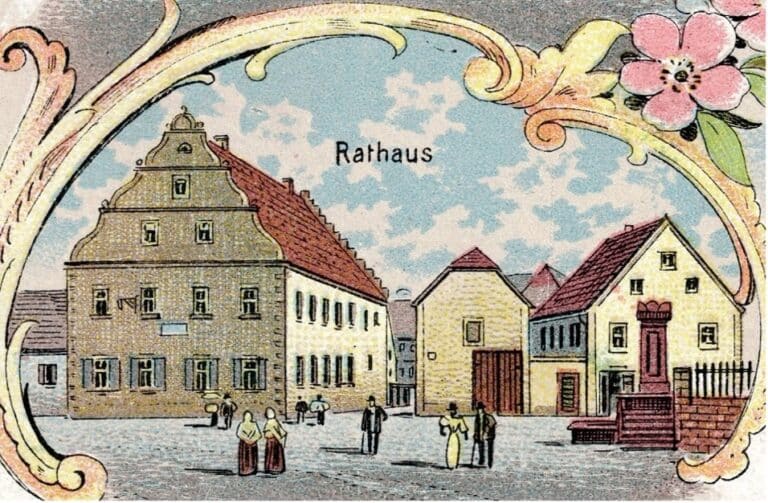
Rimpar – Market Square; 19th-century lithograph
Photo: Hans Winzlmaier
In Rimpar, the church was in a poor structural condition and there had been a long-standing shortage of space—the population had grown to over 1,700 people by 1843. After nearly six years of tough struggle against the authorities, but also against resistance from within the community, Pastor Michael Müller succeeded in having the neo-Gothic church in Rimpar built between 1849 and 1854. In the process, the original west-east orientation was abandoned and the new church was aligned to the south. The Late Gothic chancel in the bell tower from the Late Middle Ages was preserved, and after the demolition of the old Grumbach burial vault, the surviving tombs were set up inside it, including the first known work by Tilman Riemenschneider. Unfortunately, the formerly 14 Grumbach tombs had already been disposed of as construction rubble, and only half could be saved.
The synagogue of the Jewish community in Rimpar was also renovated and expanded (stair tower) at this time, in 1852.
Gradually, there was a transition from an agrarian to an industrial state, which, however, frequently brought hardship and poverty for common laborers and day workers.
Industrialization fundamentally changed the lives of many people. There arose a need for new forms of solidarity and leisure activities. An emerging bourgeoisie also wanted more self-determination and cultural participation outside of state or church structures. Thus, around the middle of the 19th century, numerous clubs and associations were founded, including in Rimpar, for example, the Liederkranz choral society in 1861 and the shooting club (Schützengilde) in 1885.
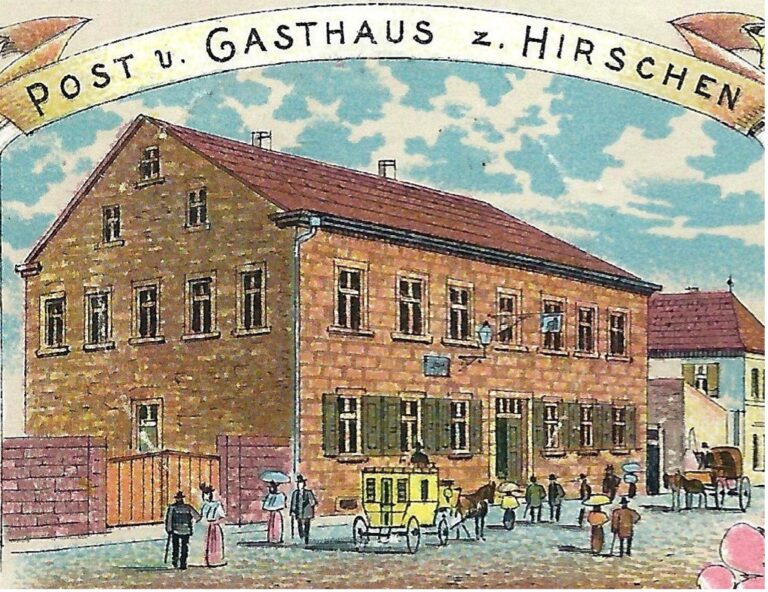
In 1854, Würzburg was connected to the railway network that had existed until then. However, the common means of transportation for Rimpar until 1907 was the stagecoach, with a station at the „Gasthaus zum goldnen Hirschen“ (also „Gasthaus zum Hirschen“, later „Zur Post“). It was then replaced by the mail bus.
Rimpar – „Gasthaus zum Hirschen“; 19th-century lithograph
Photo: Hans Winzlmaier
In 1866, the „Brothers“ War" between Austria/Bavaria and ultimately victorious Prussia for supremacy in the German-speaking region once again brought troop quartering to Rimpar, resulting in corresponding burdens for the population and the municipal treasury.
On July 19, 1870, the Franco-Prussian War broke out because France feared the unification of the various German states under Prussian leadership and saw its supremacy in Europe endangered. The war ended in 1871 with a victory for the German federation of states and the proclamation of the Prussian King Wilhelm I as German Emperor. Bavaria now became part of the new „German Empire“ (1871–1918).
As a memorial to these two wars, a monument was erected in Rimpar in 1903, which contained the names of the participants in the war, including the three fallen soldiers, and was placed in front of the church. In 1952, it was relocated to the old cemetery.
An economic boom followed in Germany, and Rimpar also underwent a transformation. Several brickworks („brick huts“) were established, and „peasant“ Rimpar gradually turned into a village of masons. This was also due to a growing population. As a result of the division of inheritances, the farms had become increasingly smaller and less profitable.
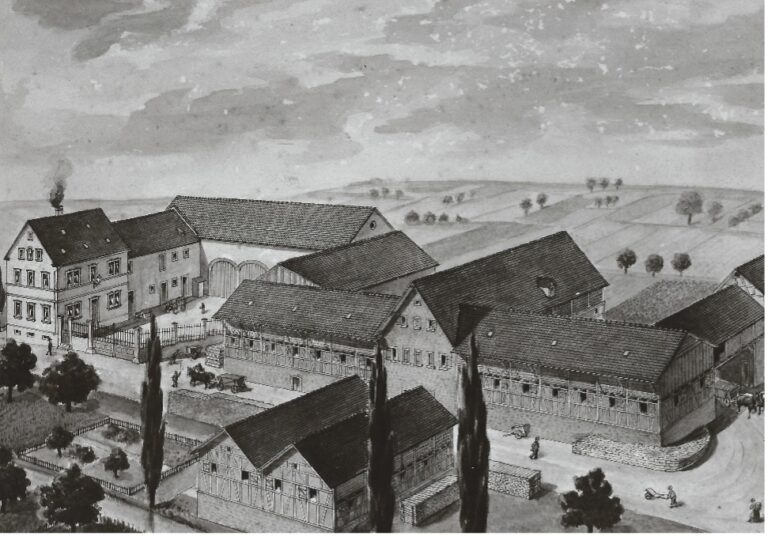
Rimpar – Brickworks of Josef Schömig at Bachgasse; 19th-century lithograph
Photo: Hans Winzlmaier
On May 2, 1887, Rimpar was struck by a severe storm, which the forest master at the time, Ley, who wrote a call for help for the residents, described as follows: „A cloudburst fell upon the local fields. The floods rolled down into the valley, devastated fields and vineyards, submerged a large part of the village—which had a population of 2,347—in water and mud, knocked down buildings and walls, washed away furniture, suffocated livestock in their stables, and even damaged the roadbed in several places.“ (Hamberger, 1995, p. 3)
Towards the end of the 19th century, the Royal Bavarian government recognized the necessity of educational reform, in particular the need for new schools.
As early as 1820, a „new schoolhouse“ had been built in Rimpar between the church and the cemetery. In 1865, a girls„ school (“sisters' school") was established in the former Echter pleasure and garden house on Niederhoferstraße. Finally, from 1874 to 1876, the boys' school on Hofstraße was built.
Hans Winzlmaier
Sources:
Arnold, Alfons: Rimpar, in the Glow of Princely Glory, Rimpar 1965
Arnold, Alfons: Rimpar, in the Light of the Present, Rimpar 1969
Dusel, Günter / Mais, Martin: Im Wandel der Zeit, Würzburg/Burggrumbach 2014
Hamberger, Edwin: Das alte Rimpar, Maidbronn und Gramschatz, Rimpar 1995
Kolb, Peter / Krenig, Ernst-Günter (Eds.): History of Lower Franconia, Volume 4/1, Würzburg 1998
Mintzel, Hannelore: The unknown world next door – Rimpar houses, Rimpar 2022
Zürrlein, Richard: Catholic Parish Church of St. Peter and Paul Rimpar, Art Guide, Munich, 1988
Internet sources:
https://de.wikipedia.org/wiki/Lehman_Brothers, 30.03.2025
https://www.alemannia-judaica.de/rimpar_synagoge.htm#ZurGeschichtederjüdischenGemeinde, 30.03.2025
https://wuerzburgwiki.de/wiki/Frnkisches_Herzogsschwert, 09.07.2025
The people of Rimpar celebrated the turn of the century just like the rest of Germany, but the impending First World War soon began to emerge due to the intense arms race and pursuit of power by the major European powers. Upon its outbreak in 1914, the able-bodied men of Rimpar also marched off to battle, mostly with enthusiasm and hoping for a quick end. The four years of war brought the death of beloved relatives at the front or in military hospitals for many families in the village. In the Art Nouveau villa on Hofstraße built by Dr. Borges, a field hospital cared for by nurses was established. The Jewish doctor Dr. Michael Mayer treated the wounded.
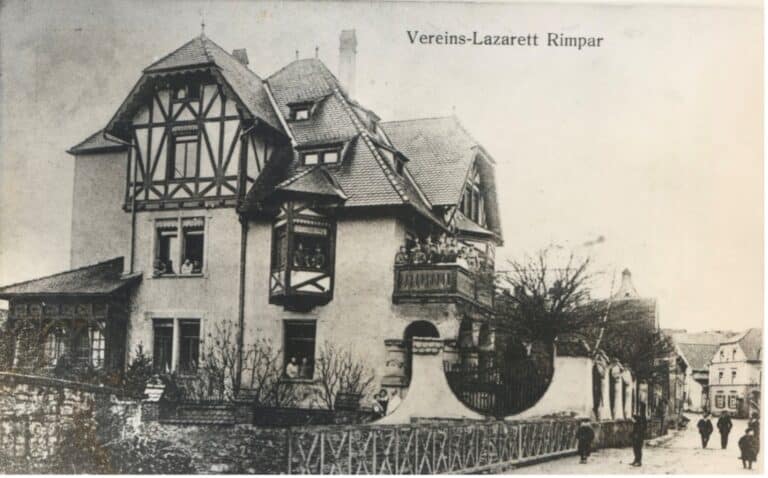
Villa Borghese
Postcard, Rimpar Municipal Archive
After the end of the war, a monument for the fallen soldiers of the village was erected at the rear cemetery wall. Even during the war, the people back home suffered great hardship, but in the post-war period, the supply situation worsened dramatically due to the burdens of the dictated peace of Versailles. High unemployment forced the masons to take part in large construction projects in distant cities. Consequently, they were often separated from their families for months at a time. During an explosion at a construction site in Oppau on September 21, 1921, seven construction workers from Rimpar died in an accident. To commemorate the victims, the „Oppau Monument“ and a wayside cross at the exit of Austraße were erected in the cemetery a year later. To alleviate the housing shortage and high unemployment, the mayor at the time, Donat Grömling, together with Pastor Josef Heeger, initiated numerous construction projects. In February 1920, a local water supply system was expanded, the pump house was built, and residents were encouraged to dig the necessary house connections. New development areas were opened up, and Rimpar grew. During this phase of new beginnings after World War I, numerous new social, sports, cultural, and political associations were founded in Rimpar. Young people no longer followed in their parents' footsteps; instead, some attended the grammar school in Lohr or chose new professions. Rimpar transformed from a village of farmers and masons into a place with a diverse range of occupations.
Already during the Great Depression, some residents of Rimpar turned to the rising National Socialist party. During an SA operation, 50-year-old Senior Sergeant Purps from Heidingsfeld suffered a heart attack on the way to Güntersleben and died. After Hitler's seizure of power in January 1933, the rapidly replaced municipal council under Mayor Ignaz Gessner changed the street names in Rimpar: Günterslebener Straße became Purps-Straße, Austraße became Adolf-Hitler-Straße, and Niederhofer Straße became Hindenburgstraße. To quickly and smoothly complete the transformation into a Nazi-compliant village, political dissidents (SPD and KPD) were taken into „protective custody“ and locked up in the fortress or in Dachau. Nevertheless, resistance stirred. At the inauguration of the new central school in 1938 in the Neue Siedlung, visitors complained that the classrooms only featured a photo of Hitler, but no crucifixes. Nazi Mayor Gessner tried in vain to ignore the ongoing protest, but had to back down—the crucifixes were hung up. The expulsion of the Jewish citizens could not be prevented. In 1942, Gessner reported Rimpar as „judenfrei“ (free of Jews)! World War II, unleashed by Hitler on September 1, 1939, brought much suffering and death back to Rimpar. The numerous fallen soldiers are listed by name on a memorial wall below the parish church. The artist Julius Bausenwein created the fitting „Grieving Woman“ sculpture in front of it.
During the war, the town of Rimpar suffered only minor building damage and got off relatively lightly. Toward the end of the war, the bells were confiscated, and the population's supply situation deteriorated. Things became dramatic here after the attack on March 16, 1945, when Rimpar had to take in about 4,000 bombed-out residents from Würzburg, in addition to an equal number of its own inhabitants. The destroyed Juliusspital was relocated to the central school, where Bishop Matthias Ehrenfried died on May 30, 1948. The occupation of Rimpar by US troops proceeded without conflict thanks to level-headed individuals, but the victors requisitioned living space, which became even scarcer due to approximately 300 expellees from the East. The cramped housing conditions, the shortage of supplies, and disruptions in the water network caused a typhoid epidemic in the town, which claimed the lives of many people—including young ones. The quarantine hospital was relocated to the "Zur Post" inn at the market square. When the saved bells returned from Hamburg on May 22, 1947, the whole village celebrated. During the political reorganization after the lost war, Mayor Engelbert Kraus played a decisive role as a member of the constituent assembly. He represented the interests of the municipality and the district in the Bavarian State Parliament for four legislative periods. Soon after the currency reform, active construction flourished. New residential areas were developed in the Krautäcker and at Schleifweg, and the new post office building was constructed in front of the Old Boys' School. Industry, such as the Reinfurt company, settled in the area.
Rimpar grew steadily and changed significantly. For the construction of a new kindergarten in 1959, Villa Borges (Hofstraße 10) was unfortunately demolished. The listed Niederhof with its Gothic architectural elements also fell victim to modernization. A new convent was built in 1964. A profound transformation also took place inside the parish church: in the course of modernization, Pastor Bauer removed the old pulpit, the communion rail, the Steinmeyer organ, and the small wooden gallery. The Pleichach river was regulated and its course altered; the „Gäulbach“ stream running around the castle in Bachgasse disappeared. The newly formed Protestant parish received its place of worship in the Greiffenclau Hall of Grumbach Castle. In 1972, due to the increased number of students, the Rimpar elementary school was divided into a primary and a secondary school, and a modern concrete building with a gym and indoor swimming pool was built for the latter near the cemetery. On May 1, 1978, through the incorporation of the two districts of Maidbronn and Gramschatz, Rimpar grew to become the second-largest municipality in the district. One of the most significant decisions was the purchase of Grumbach Castle by the municipality in 1990 under Mayor Anton Kütt.
Rimpar Castle around 1975
Photo: Prof. Dr. Detlef Busche
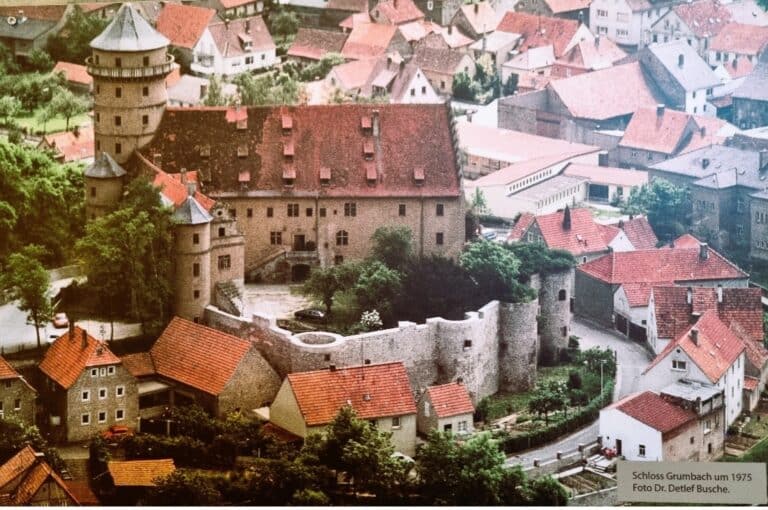
The building was in danger of falling into disrepair; only a few rooms were being used by the state forestry office. The year 1973 marked the end of the forestry office. In a letter dated April 4, 1978, Christian Will, then a member of the state parliament, wrote to Albert Meyer, the State Secretary of Finance, proposing that the castle be used as city hall. Mayor Anton Kütt and State Secretary Albert Mayer welcomed this proposal. Since there was no support for a purchase in 1980, Edwin Hamberger founded the interest group “Friends of Grumbach Castle” to spark interest in the building through guided tours and lectures. In July 1980, the market town council unanimously approved the purchase of the castle.
Generous government funding secured with the help of State Parliament Member Christian Will, along with volunteer work by the Friends of Grumbach Castle, made it possible to carry out a renovation in accordance with historic preservation standards. After a four-year renovation that cost approximately 6 million DM—with the Free State of Bavaria subsidizing 50 % of the cost—the administration was able to move in in 1985. The Friends of Grumbach Castle, founded in 1980, painstakingly established the castle museums in 2000.
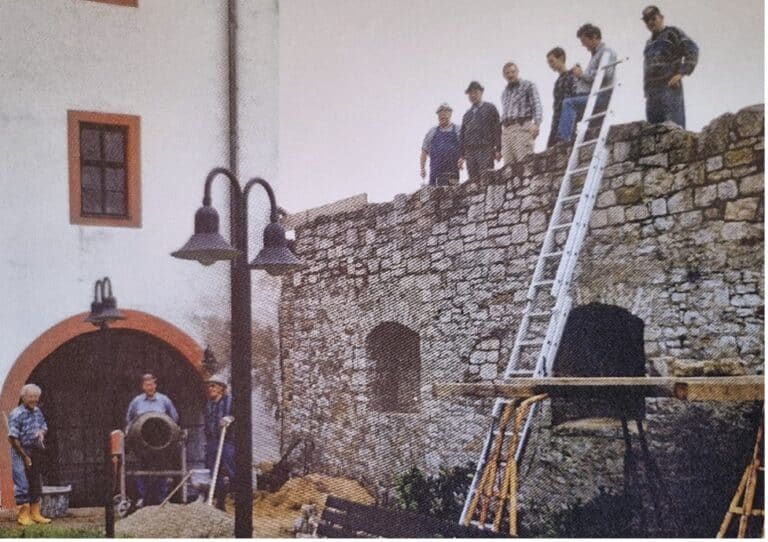
Members of the Friends of Grumbach Castle with Mayor Anton Kütt during restoration work at the castle
Photo: Kurt Mintzel in: Hamberger, Edwin: 40 Years of the Friends of Grumbach Castle, Rimpar 2019
Today, the castle serves as the seat of the municipal government and is also the town's cultural hub.
Hanne Mintzel
Sources:
Alfons Arnold: Chronicle, Vol. 3: Rimpar, in the Light of the Present
Mainpost Archive
Rimpar Municipal Archives
The new millennium began in Rimpar with the opening of the Rimpar Castle Museums. In 2000, the Archaeological Museum, the Bakery Museum, and the Crime Museum opened at Grumbach Castle; the Masonry and Carpentry Museum and the Traditional Costume Museum followed in 2010.
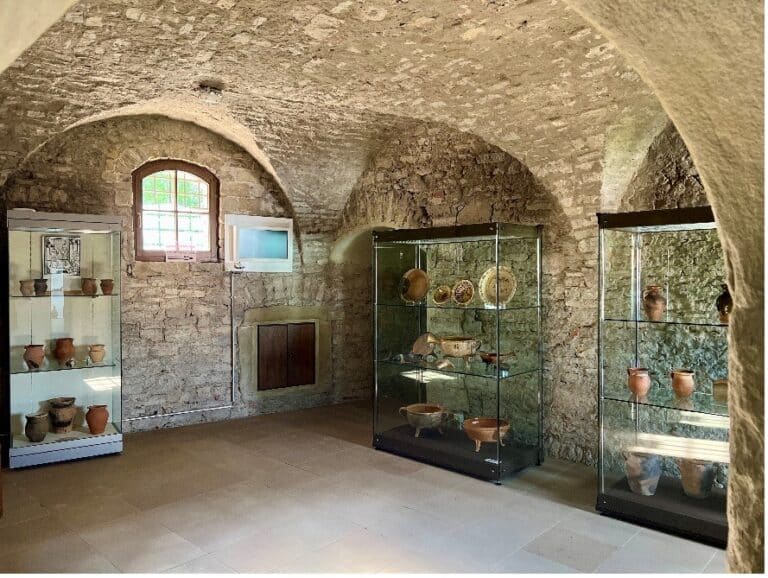
A view of the display cases at the Archaeological Museum
Photo: Nadja Kess
In 2002, Burkard Losert was elected mayor of the town of Rimpar and held the office until 2020. He was succeeded by Bernhard Weidner, who led the town until 2026. Since May 1, 2026, Torsten Keller the new mayor of Rimpar.
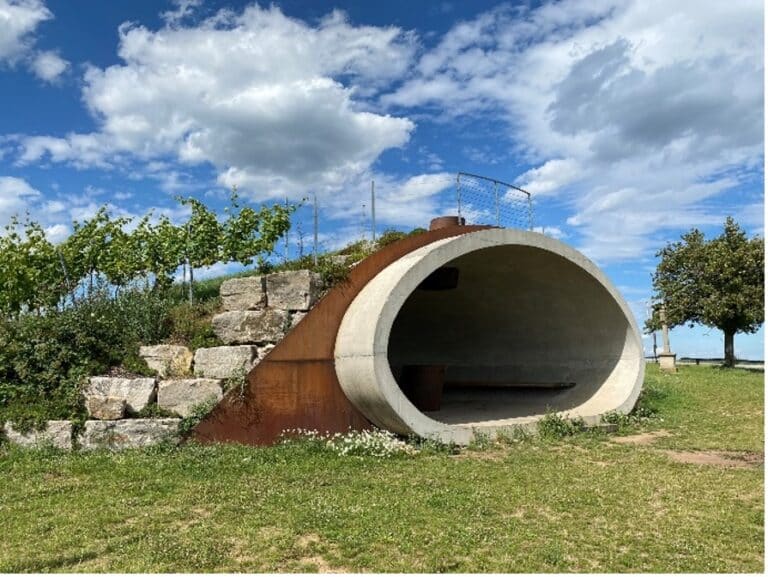
The programs offered by the Gramschatzer Wald Forest Experience Center, which opened in 2007, invite not only residents of Rimpar but also residents of the surrounding district and tourists of all ages to explore informative, hands-on, and entertaining topics. It can be reached via the biking and hiking trail—which was expanded that same year—from Rimpar through the Burggrumbacher Graben to the Waldhaus Einsiedel. Other informative hiking trails include the European Culture Trail (2010) with its two routes and the Bach Rundweg (2011). A popular destination not only for locals is the „Kobel“ on the Kobersberg, inaugurated in 2016, with its wine hiking trail. At the magical „terroir-f“ spot, hikers can rest on the lounge chairs provided or simply enjoy the panoramic views. Incidentally, the Rimpar „terroir-f“ spot took third place on the BR program „Bayern’s Most Beautiful Spot“ and was honored by the Franconian Wine Region in 2025. It has also been featured in a segment on MDR.
The magical spot in Rimpar—the “terroir f” spot on the Kobel on Rimpar’s Kobersberg
Photo: Nadja Kess
What has always been particularly important in Rimpar is the social aspect. In order to respond to changing circumstances and give young parents the opportunity to return to working life soon, four nurseries were established in Rimpar's daycare facilities between 2004 and 2009. In 2006, the „Rimparer Strolche“ after-school care center was built. A few years later, this was followed by the construction of the „Tintenklecks“ after-school care center at the Maximilian-Kolbe-School and the construction of a nursery at the Rappelkiste kindergarten on Schäfereistraße. The „Bachzwerge“ daycare center opened in 2023. Judith Gerlach, the then Bavarian State Minister for Digital Affairs, was also a guest at the opening. The Matthias-Ehrenfried-School and the parking lot there were completely renovated, and the schoolyard of the Maximilian-Kolbe-School was redesigned. After the secondary school in particular lost students due to the increased transition to secondary schools, the market town council was forced to order its closure at the end of the 2023 school year. The students now attend the school in Unterpleichfeld. The municipality sold the building of the Matthias-Ehrenfried-Elementary School in Neue Siedlung to the district in 2023. The building in Neue Siedlung will then be remodeled. Classes for a special needs school will begin in the 2026/27 school year. The elementary school students will move into the former Maximilian-Kolbe-School at the beginning of the school year in fall 2025. It will then be called the Matthias-Ehrenfried-School.
One issue that has increasingly come into focus from 2000 to 2025 is the environment. A lot has happened in this area in Rimpar as well. For example, in 2007–2008, a wood-chip heating system with a local heat supply was built for the Old Gymnasium, the „Rimparer Strolche“ daycare center, and the Matthias-Ehrenfried School. The latter became one of 70 energy-efficient schools recognized throughout Germany. In 2015, the street lighting was converted to LED. This conversion results in energy savings of 65%. In 2017, the wood chip heating plant building was completed, including connections to the Maximilian-Kolbe School and the triple-purpose sports hall. In 2018, the district heating pipeline was installed, connecting the municipal and church buildings (triple-purpose sports hall, DJK hall, Maximilian Kolbe School, church, youth center, rectory, Herrngasse 13, Bischof-Schmitt-Haus, nuns’ residence, Old City Hall and Ratsapotheke, Old Boys’ School, Schlossmühl Kindergarten, and the castle). The planned medical center on Niederhoferstraße already has a utility connection to the property. More and more residents are driving electric cars, so an EV charging station was installed on Hofstraße in 2018.
Between 2000 and 2025, several construction projects were completed. Like many other towns, Rimpar has had to deal with numerous—and in some cases major—water main breaks; the pipes are getting old. This made it urgently necessary to repair the sewer and water lines and resurface the road in Weinbergstraße. The water line in the street „Zur Veitsmühle“ was also completely renovated.
The old gymnasium in the Neue Siedlung was completely renovated, and the former boys„ school was completed as the “Haus der Vereine„ (House of Clubs). Construction of the new town center began on Hofstraße. With the demolition of the former post office building, the way was now clear for the construction of the “Partnership Square” between the old town hall and the Old Boys’ School. The light-colored paving and the built-in water features invite young and old alike to linger.
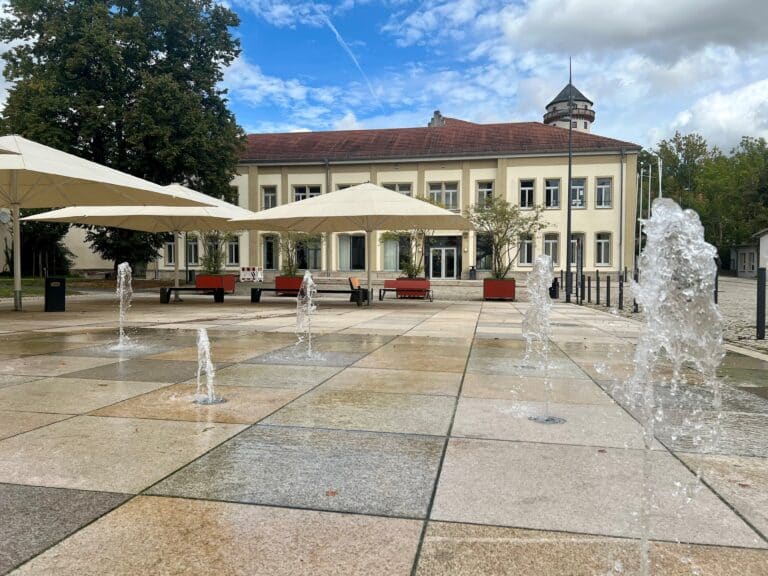
The „Old Post Office“ once stood here—now the newly created „Partnership Square“ invites visitors to linger.
Photo: Nadja Kess
The new town center also included the complete renovation and paving of Hofstraße. In 2018, the new town center on Hofstraße gained another highlight: the Pleichach Terraces were opened. In addition to a beautifully landscaped area along the Pleichach with seating, there is also a bocce court and a carousel for children. The „book cabinet“—an old phone booth converted into bookshelves—is also very popular and underscores the purpose of the square: bringing people together. Parking spaces were created at the “Alte Schmiede” on Niederhoferstraße, and a parking and green area was established next to the pharmacy, featuring seating and plenty of greenery.
The area around the „Platz der Partnerschaft“ has now established itself, as intended, as a gathering place. Every year, the Maypole raising takes place here, as well as many other festivals and celebrations, such as the Rimpar Castle Festival—known far beyond Rimpar—and the Rimpar Village Christmas, which took place for the first time in 2019. The commitment of Rimpar’s residents to the town’s many clubs and organizations deserves special mention. Those in leadership roles help ensure that community cohesion is strengthened and that traditions and customs remain alive.
High-speed internet is becoming increasingly important. Especially with the onset of the corona pandemic in 2019, many people worked from home and students were also taught online. All the greater was the joy that by 2024 the entire town was supplied with fiber optics.
Nadja Kess
Source:
Municipal archive
The town hall is open today at the following times:
Then simply contact us at any time using the following contact options:

News

Our employees

events

Local map

Form center

900 years Rimpar
Council Information Portal

Stiftung unser Markt Rimpar